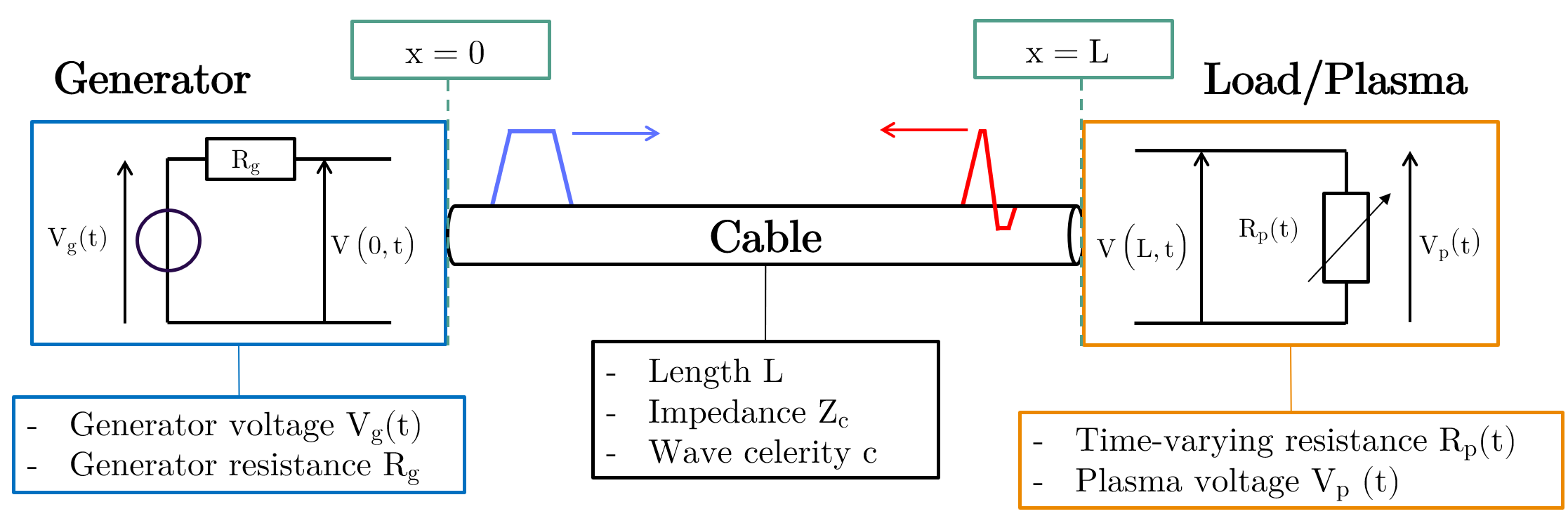
Determination of cable properties.#
This example shows how to determine the properties of a coaxial cable from experimental data, and compare them to the datasheet values.
# This sets the third figure as the thumbnail for the example gallery.
# sphinx_gallery_thumbnail_number = 3
# This displays each image separately in the example gallery.
# sphinx_gallery_multi_image = "single"
First, we import the required libraries.#
We start by importing the modules we need:
matplotlib for drawing graphs,
numpy for array functions,
pyresiflex for the generator, load and transmission line.
import matplotlib.pyplot as plt
import numpy as np
import yaml

import pyresiflex.misc.units as u
from pyresiflex.misc.plot import plot_voltage_current, set_mpl_style
from pyresiflex.misc.utils import get_path_to_data

set_mpl_style(nb_columns=2)
Load [Minesi2022] experimental data of remote configuration.#
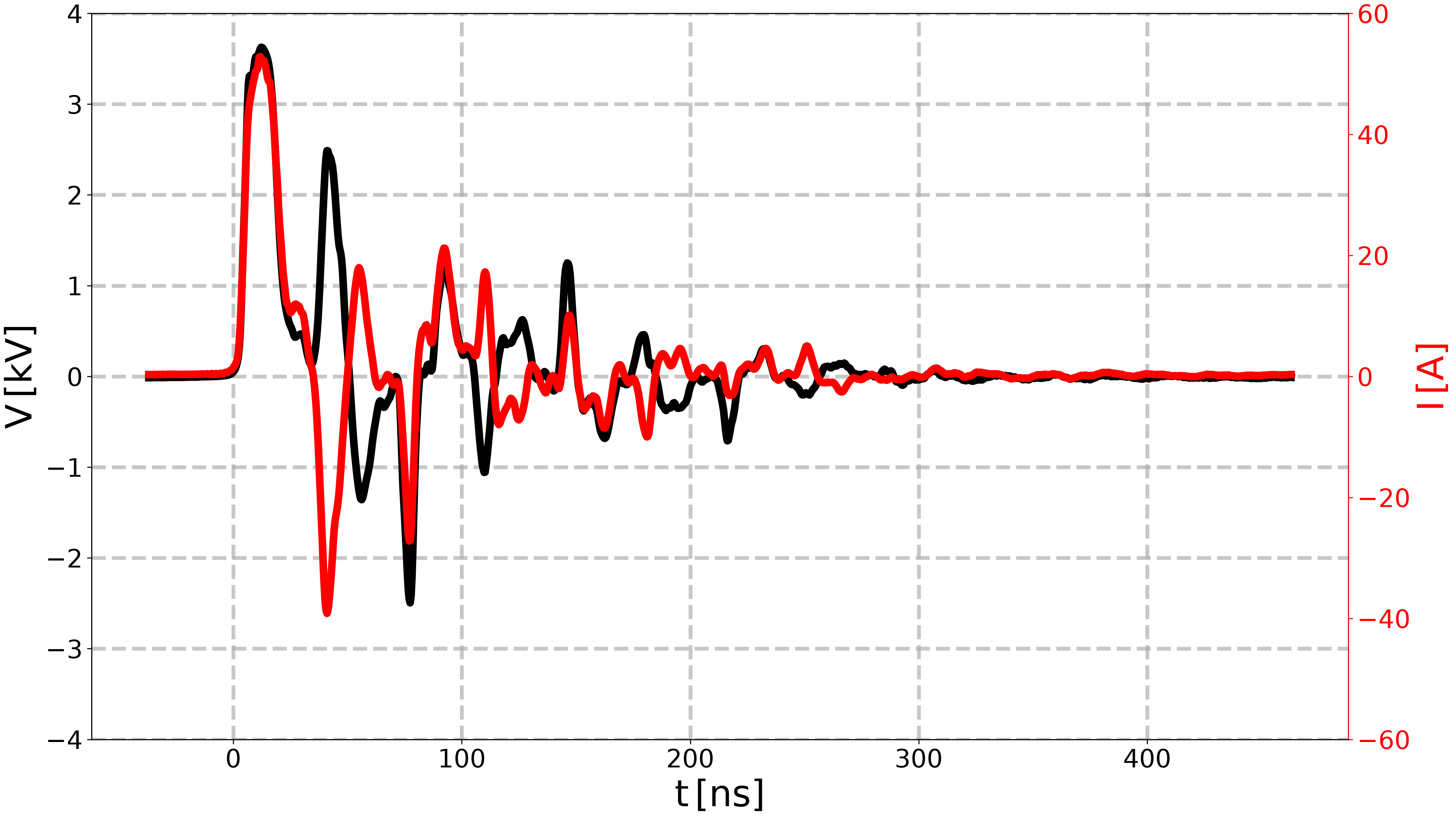
# Load the raw data from Figure 16 of [Minesi2022]_.
file = get_path_to_data(
    "Minesi2022",
    "fig16_remoteConfiguration.csv",
)
data = np.loadtxt(file, skiprows=3, delimiter=";")
times_raw = data[:, 0] * 1e-9  # [s]
voltages_raw = data[:, 1] * 1e3  # [V]
currents_raw = data[:, 3]  # [A]


# Plot the raw data.
fig, ax_v, ax_i = plot_voltage_current(
    voltage_time=times_raw,
    voltage_value=voltages_raw,
    current_time=times_raw,
    current_value=currents_raw,
)
ax_v.set_ylim(-4, 4)
ax_i.set_ylim(-60, 60)

plt.show()
Preprocess the data.#
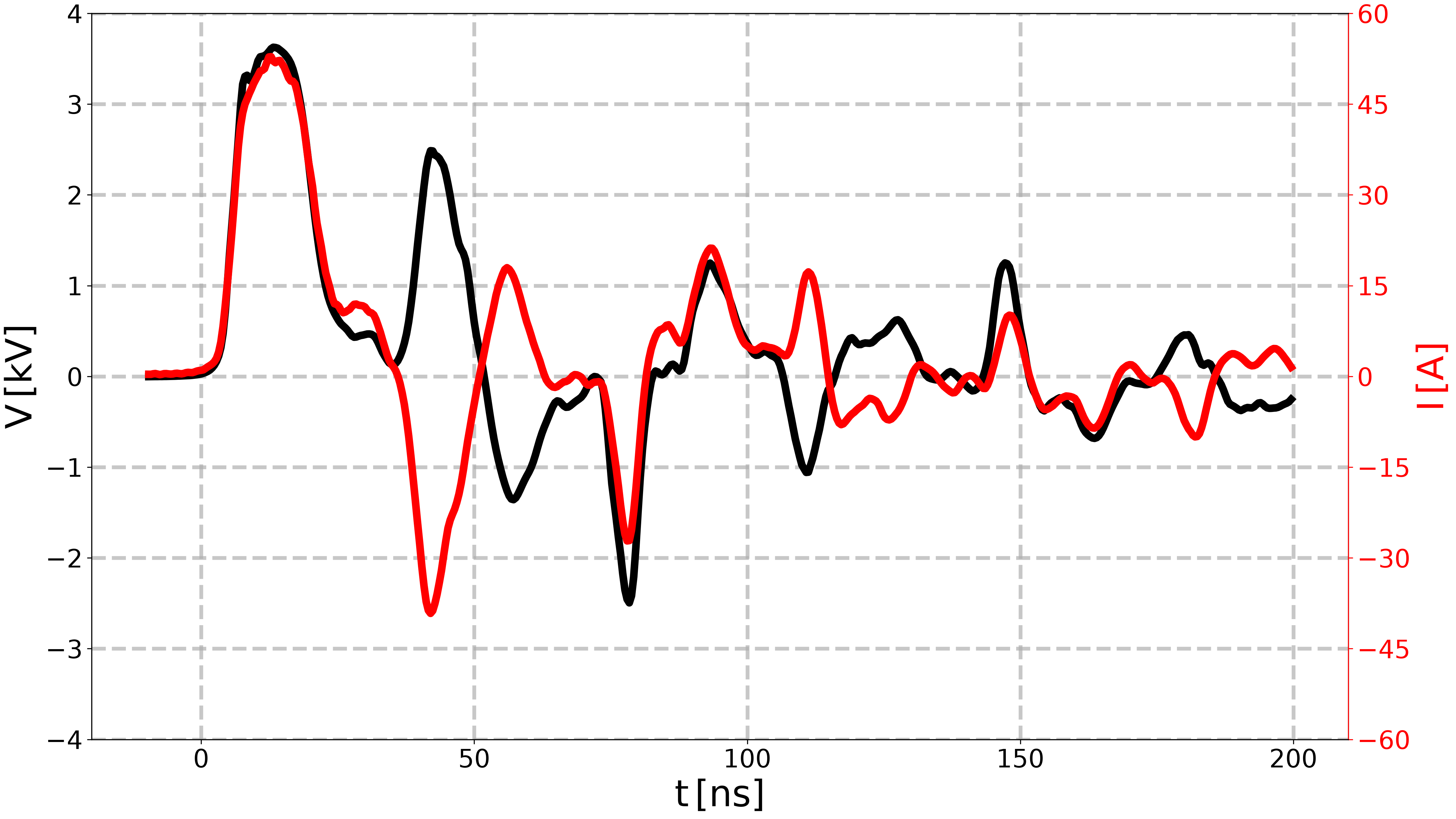
# Define the zero at the first time the voltage reaches `threshold_voltage`.
threshold_voltage = 25  # [V]
idx_first = np.where(np.abs(voltages_raw) > threshold_voltage)[0][0]
times_raw = times_raw - times_raw[idx_first]

# Define a time window to analyze.
lower_time_window = -10e-9  # [s]
upper_time_window = 200e-9  # [s]

# Limit the time window to [lower_time_window, upper_time_window]
idx_min_wanted_time = np.where(times_raw > lower_time_window)[0][0]
idx_max_wanted_time = np.where(times_raw > upper_time_window)[0][0]

# Limit the time, voltages and currents to the wanted period.
times_expe = times_raw[idx_min_wanted_time:idx_max_wanted_time]
voltages_expe = voltages_raw[idx_min_wanted_time:idx_max_wanted_time]
currents_expe = currents_raw[idx_min_wanted_time:idx_max_wanted_time]


# Plot the preprocessed data.
fig, ax_v, ax_i = plot_voltage_current(
    voltage_time=times_expe,
    voltage_value=voltages_expe,
    current_time=times_expe,
    current_value=currents_expe,
)
ax_v.set_ylim(-4, 4)
ax_i.set_ylim(-60, 60)
ax_i.set_yticks([-60, -45, -30, -15, 0, 15, 30, 45, 60])

plt.show()
Determine the time delay between the incident and reflected wave.#
# Find the points where the voltage reaches 2 kV.
# Change this value to observe the time delay at different voltage levels.
t_2kV = times_expe[np.where(np.abs(voltages_expe - 2000) < 100)[0]]
print(f"Times when voltage reaches 2 kV: {t_2kV * 1e9} ns")
# Time difference between detection of 2 kV, for the first rising edge.
delta_t = t_2kV[2] - t_2kV[0]  # [s]
print(
    "Time difference between the incident"
    f" and reflected wave: {delta_t * 1e9} ns"
)

fig, ax_v, ax_i = plot_voltage_current(
    voltage_time=times_expe,
    voltage_value=voltages_expe,
    current_time=times_expe,
    current_value=currents_expe,
)
ax_v.set_ylim(-4, 4)
ax_i.set_ylim(-60, 60)
ax_i.set_yticks([-60, -45, -30, -15, 0, 15, 30, 45, 60])

ax_v.axvline(t_2kV[0] * 1e9, color="blue", linestyle="--", lw=3)
ax_v.axvline(t_2kV[2] * 1e9, color="blue", linestyle="--", lw=3)
ax_v.text(
    t_2kV[0] * 1e9,
    -3,
    "Incident wave (2 kV)",
    color="blue",
    ha="center",
    bbox=dict(facecolor="white", alpha=0.7, edgecolor="none"),
)
ax_v.text(
    t_2kV[2] * 1e9,
    3,
    "Reflected wave (2 kV)",
    color="blue",
    ha="center",
    bbox=dict(facecolor="white", alpha=0.7, edgecolor="none"),
)

plt.show()
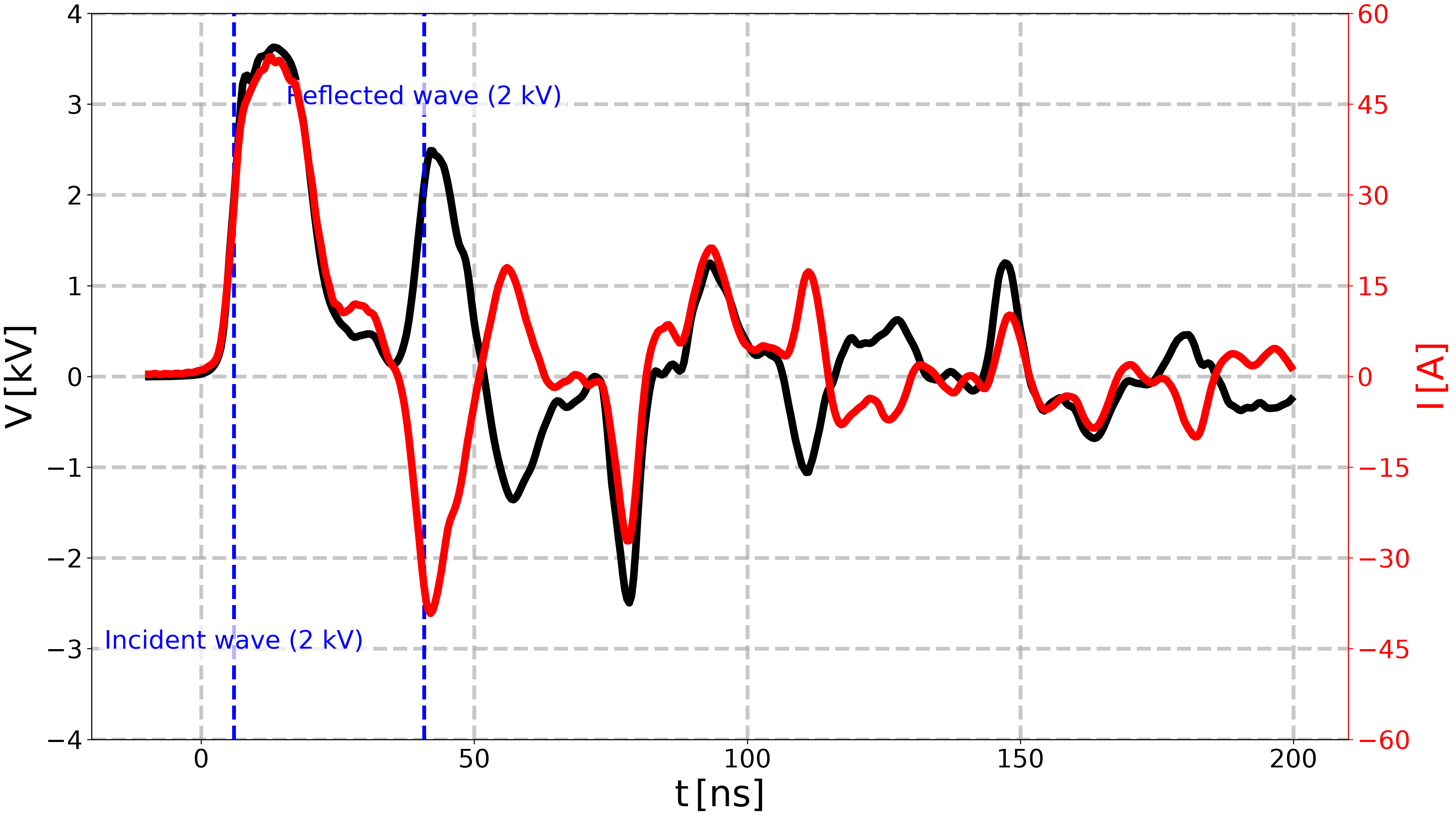
Times when voltage reaches 2 kV: [ 6.  20.4 40.8 45.6] ns
Time difference between the incident and reflected wave: 34.8 ns
Determine the cable properties from the datasheet.#
We will use the datasheet to get the celerity and characteristic impedance. We will then use the time delay to get the length of the cable.
# In [Minesi2022]_, the cable used was a AlphaWire 9011A RG11A/U.
# Data come from the datasheet of the AlphaWire 9011A RG11A/U cable,
# in "./src/pyresiflex/data/Minesi2022/Alpha Wire 9011A Tech Data.pdf".
# The cable has the following properties:
c_datasheet = 0.66 * u.c_0  # [m/s]
Z_c_datasheet = 75  # [Ohm]


# We need to make an assumption on the position of the probes.
# Here, we assume that the probes are located at the same position,
# at the middle of the cable.
# x = L / 2
#
# Then, the wave velocity is given by:
#   c = 2 * (L - x) / delta_t
#     = L / delta_t
# Thus, the length of the cable is:
L_from_datasheet = c_datasheet * delta_t  # [m]
Determine the cable properties from the experimental data.#
[Minesi2022] provides the cable length used, roughly 6 m. However, there were two cables of 3 m connected in series, via a box, where probes are connected. This box adds some additional length, roughly 0.2 m. Thus, we will assume that the length of the cable is:
L_experimental = 6.2  # [m]
# [Minesi2022]_ also provides the probe positions, at the middle of the cable.
x_experimental = L_experimental / 2  # [m]

# time delay between the incident and reflected wave (for 2 kV).
delta_t = 34.8e-9  # [s]
# Uncertainties on the measurements:
# .. Uncertainty on the length of the cable, due to the box.
ΔL_expe = 0.1  # [m]
# .. Uncertainty on the position of the probes, due to the box.
Δx_expe = 0.1  # [m]
# .. Uncertainty on the time delay, after playing with the threshold voltage.
Δdelta_t = 1e-9  # [s]

# Then, the wave velocity is given by:
c_experimental = 2 * (L_experimental - x_experimental) / delta_t
# .. Uncertainty on the wave velocity, using error propagation:
Δc_experimental = c_experimental * np.sqrt(
    (ΔL_expe / (L_experimental - x_experimental)) ** 2
    + (Δx_expe / (L_experimental - x_experimental)) ** 2
    + (Δdelta_t / delta_t) ** 2
)

print(
    f"Experimental celerity: {c_experimental:.2e} m/s"
    f" ± {Δc_experimental:.2e} m/s"
)

# The characteristic impedance can be determined from the maximum voltage
# and current of the incident wave:
max_voltage = np.max(voltages_expe)
max_current = np.max(currents_expe)
Z_c = max_voltage / max_current
Δmax_voltage = 100  # [V]
Δmax_current = 1  # [A]
ΔZ_c = Z_c * np.sqrt(
    (Δmax_voltage / max_voltage) ** 2 + (Δmax_current / max_current) ** 2
)
print(
    f"Experimental maximum voltage: {max_voltage:.2f} V ± {Δmax_voltage:.2f} V"
)
print(
    f"Experimental maximum current: {max_current:.2f} A ± {Δmax_current:.2f} A"
)
print(f"Experimental characteristic impedance: {Z_c:.2f} Ω ± {ΔZ_c:.2f} Ω")
Experimental celerity: 1.78e+08 m/s ± 9.61e+06 m/s
Experimental maximum voltage: 3626.63 V ± 100.00 V
Experimental maximum current: 52.84 A ± 1.00 A
Experimental characteristic impedance: 68.63 Ω ± 2.30 Ω
Compare the results.#
print("Cable properties from datasheet:")
print(f"  Length: {L_from_datasheet:.2f} m")
print(f"  Celerity: {c_datasheet / u.c_0:.2f} c = {c_datasheet:.2e} m/s")
print(f"  Characteristic impedance: {Z_c_datasheet:.2f} Ω")
print("")
print("Cable properties from experimental data:")
print(f"  Length: {L_experimental:.2f} m ± {ΔL_expe:.2f} m")
print(
    f"  Celerity: {c_experimental / u.c_0:.2f} c ="
    f" {c_experimental:.2e} m/s ± {Δc_experimental:.2e} m/s"
)
print(f"  Characteristic impedance: {Z_c:.2f} Ω ± {ΔZ_c:.2f} Ω")
Cable properties from datasheet:
  Length: 6.89 m
  Celerity: 0.66 c = 1.98e+08 m/s
  Characteristic impedance: 75.00 Ω

Cable properties from experimental data:
  Length: 6.20 m ± 0.10 m
  Celerity: 0.59 c = 1.78e+08 m/s ± 9.61e+06 m/s
  Characteristic impedance: 68.63 Ω ± 2.30 Ω
Determine the internal resistance of the generator.#
# Time windows for the first incident pulse, the first reflected pulse,
# and the second incident pulse.
pulse_1i_mask = (times_expe >= 0) & (times_expe <= 35e-9)
pulse_1r_mask = (times_expe >= 35e-9) & (times_expe <= 70e-9)
pulse_2i_mask = (times_expe >= 70e-9) & (times_expe <= 105e-9)

# Compute max voltage on these time windows, and associated times.
max_voltage_1i = np.max(np.abs(voltages_expe[pulse_1i_mask]))
max_voltage_1r = np.max(np.abs(voltages_expe[pulse_1r_mask]))
max_voltage_2i = np.max(np.abs(voltages_expe[pulse_2i_mask]))
idx_max_voltage_1i = np.argmax(np.abs(voltages_expe[pulse_1i_mask]))
idx_max_voltage_1r = np.argmax(np.abs(voltages_expe[pulse_1r_mask]))
idx_max_voltage_2i = np.argmax(np.abs(voltages_expe[pulse_2i_mask]))
time_max_voltage_1i = times_expe[pulse_1i_mask][idx_max_voltage_1i]
time_max_voltage_1r = times_expe[pulse_1r_mask][idx_max_voltage_1r]
time_max_voltage_2i = times_expe[pulse_2i_mask][idx_max_voltage_2i]
sign_1i = np.sign(voltages_expe[pulse_1i_mask][idx_max_voltage_1i])
sign_1r = np.sign(voltages_expe[pulse_1r_mask][idx_max_voltage_1r])
sign_2i = np.sign(voltages_expe[pulse_2i_mask][idx_max_voltage_2i])

# Plot the voltage signal and the max voltages on the three pulses.
fig, ax = plt.subplots()
ax.plot(
    times_expe * 1e9,
    voltages_expe * 1e-3,
    color="black",
    label="Measured voltage",
)
for time, voltage, sign in zip(
    [time_max_voltage_1i, time_max_voltage_1r, time_max_voltage_2i],
    [max_voltage_1i, max_voltage_1r, max_voltage_2i],
    [sign_1i, sign_1r, sign_2i],
):
    ax.scatter(
        time * 1e9,
        voltage * sign * 1e-3,
        color="red",
        s=200,
        zorder=3,
    )
    ax.text(
        time * 1e9,
        voltage * sign * 1e-3,
        f"({time * 1e9:.1f} ns, {voltage * sign * 1e-3:.2f} kV)",
        color="red",
        ha="center",
        va="bottom" if sign > 0 else "top",
    )


ax.set_xlabel(r"$\mathregular{t \, [ns]}$")
ax.set_ylabel(r"$\mathregular{V \, [kV]}$")
ax.set_xlim(0, 100)
ax.set_ylim(-2.6, 4)
ax.legend()

plt.show()


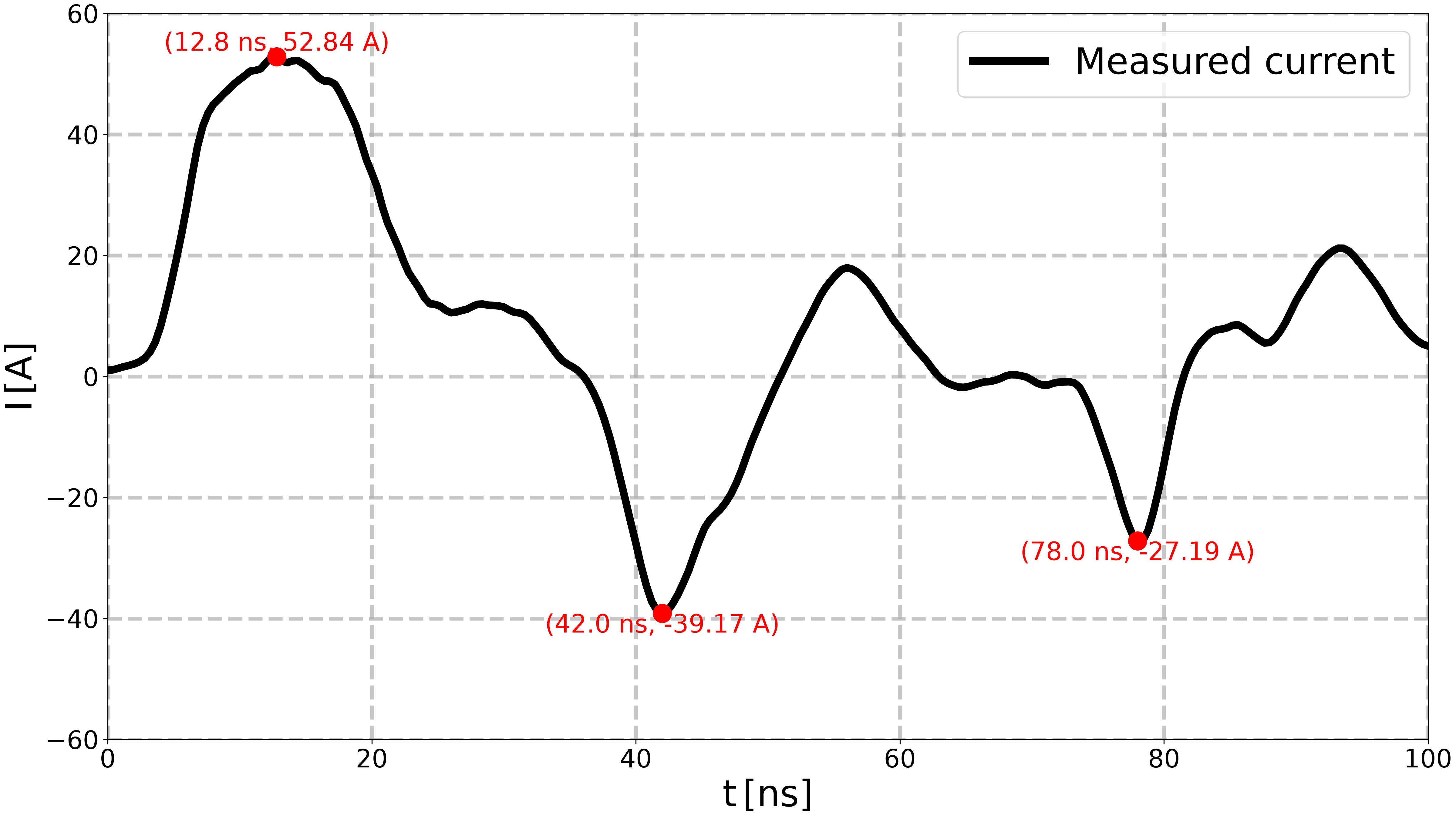
# Do the same, but with current instead of voltage.
# Compute max current on the time windows, and associated times.
max_current_1i = np.max(np.abs(currents_expe[pulse_1i_mask]))
max_current_1r = np.max(np.abs(currents_expe[pulse_1r_mask]))
max_current_2i = np.max(np.abs(currents_expe[pulse_2i_mask]))
idx_max_current_1i = np.argmax(np.abs(currents_expe[pulse_1i_mask]))
idx_max_current_1r = np.argmax(np.abs(currents_expe[pulse_1r_mask]))
idx_max_current_2i = np.argmax(np.abs(currents_expe[pulse_2i_mask]))
time_max_current_1i = times_expe[pulse_1i_mask][idx_max_current_1i]
time_max_current_1r = times_expe[pulse_1r_mask][idx_max_current_1r]
time_max_current_2i = times_expe[pulse_2i_mask][idx_max_current_2i]
sign_1i = np.sign(currents_expe[pulse_1i_mask][idx_max_current_1i])
sign_1r = np.sign(currents_expe[pulse_1r_mask][idx_max_current_1r])
sign_2i = np.sign(currents_expe[pulse_2i_mask][idx_max_current_2i])

fig, ax = plt.subplots()
ax.plot(
    times_expe * 1e9,
    currents_expe,
    color="black",
    label="Measured current",
)
for time, current, sign in zip(
    [time_max_current_1i, time_max_current_1r, time_max_current_2i],
    [max_current_1i, max_current_1r, max_current_2i],
    [sign_1i, sign_1r, sign_2i],
):
    ax.scatter(
        time * 1e9,
        current * sign,
        color="red",
        s=200,
        zorder=3,
    )
    ax.text(
        time * 1e9,
        current * sign,
        f"({time * 1e9:.1f} ns, {current * sign:.2f} A)",
        color="red",
        ha="center",
        va="bottom" if sign > 0 else "top",
    )

ax.set_xlabel(r"$\mathregular{t \, [ns]}$")
ax.set_ylabel(r"$\mathregular{I \, [A]}$")
ax.set_xlim(0, 100)
ax.set_ylim(-60, 60)
ax.legend()
plt.show()


# Now, we can compute the resistance, either from voltage or from current:
Rg_voltage = (
    Z_c * (max_voltage_1r - max_voltage_2i) / (max_voltage_1r + max_voltage_2i)
)
Rg_current = (
    Z_c * (max_current_1r - max_current_2i) / (max_current_1r + max_current_2i)
)
print(f"Internal resistance of the generator from voltage: {Rg_voltage:.2f} Ω")
print(f"Internal resistance of the generator from current: {Rg_current:.2f} Ω")
# Note that the value of Rg_voltage is negative, which is not physical.
# This is due to the fact that the max voltage of the reflected pulse is
# slightly higher than the max voltage of the second incident pulse,
# which can be explained by measurement uncertainties.
# We will therefore use the value of Rg_current for the rest of the example.

# Evaluation of the incertitude on Rg:
I_1r = max_current_1r
I_2i = max_current_2i
ΔI_1r = 1  # [A]
ΔI_2i = 1  # [A]
print(f"Experimental maximum current: {max_current_1r:.2f} A ± {ΔI_1r:.2f} A")
print(f"Experimental maximum current: {max_current_2i:.2f} A ± {ΔI_2i:.2f} A")

ΔR_g = Rg_current * np.sqrt(
    (ΔZ_c / Z_c) ** 2
    + 4
    * ((I_2i * ΔI_1r) ** 2 + (I_1r * ΔI_2i) ** 2)
    / ((I_1r) ** 2 - (I_2i) ** 2) ** 2
)
print(
    "Estimated internal resistance of the generator:"
    f" {Rg_current:.2f} ± {ΔR_g:.2f} Ω"
)


# Computation of the attenuation factor between the generator and the cable:
alpha_g = Z_c / (Z_c + Rg_current)
print(f"Attenuation factor between the generator and the cable: {alpha_g:.2f}")

Δalpha_g = (
    alpha_g**3 / Z_c * np.sqrt((ΔR_g) ** 2 + (ΔZ_c * Rg_current / Z_c) ** 2)
)
print(
    "Estimated attenuation factor between the generator and the cable:"
    f" {alpha_g:.2f} ± {Δalpha_g:.2f}"
)
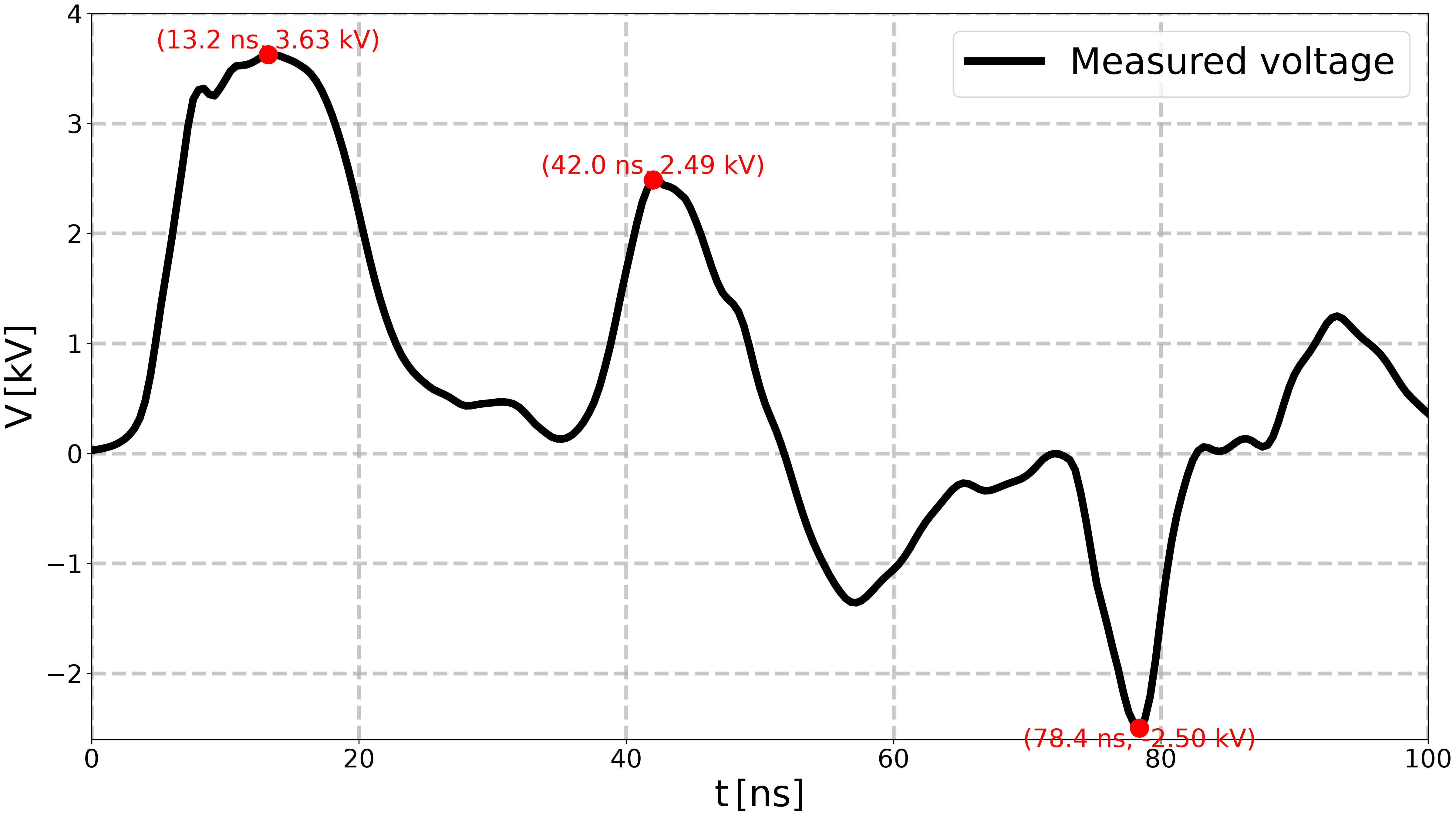
Internal resistance of the generator from voltage: -0.12 Ω
Internal resistance of the generator from current: 12.39 Ω
Experimental maximum current: 39.17 A ± 1.00 A
Experimental maximum current: 27.19 A ± 1.00 A
Estimated internal resistance of the generator: 12.39 ± 1.54 Ω
Attenuation factor between the generator and the cable: 0.85
Estimated attenuation factor between the generator and the cable: 0.85 ± 0.01
Write experimental results to a .yaml file.#
experimental_results = {
    "description": (
        "Cable properties determined from Minesi2022 experiments,"
        " with the assumption that the probes are located at the middle"
        " of the transmission line."
    ),
    "celerity": {
        "value": float(c_experimental),
        "uncertainty": float(Δc_experimental),
    },
    "characteristic_impedance": {
        "value": float(Z_c),
        "uncertainty": float(ΔZ_c),
    },
    "length": {"value": float(L_experimental), "uncertainty": float(ΔL_expe)},
    "x_meas": {"value": float(x_experimental), "uncertainty": float(Δx_expe)},
    "internal_resistance_generator": {
        "value": float(Rg_current),
        "uncertainty": float(ΔR_g),
    },
    "attenuation_factor_generator_cable": {
        "value": float(alpha_g),
        "uncertainty": float(Δalpha_g),
    },
}
with open(
    get_path_to_data("Minesi2022", "cable_properties.yaml", force_return=True),
    "w",
    encoding="utf-8",
) as file:
    yaml.dump(
        experimental_results,
        file,
        encoding="utf-8",
        sort_keys=False,
        # Do not wrap long lines (e.g. the description), so the output
        # matches the format enforced by the `pretty-format-yaml` hook.
        width=float("inf"),
    )
Determining if the cable can be considered perfect or not.#
Data come from the datasheet of the AlphaWire 9011A RG11A/U cable, in “./src/pyresiflex/data/Minesi2022/Alpha Wire 9011A Tech Data.pdf”.
# feet to meters conversion: 1 ft = 0.3048 m
feet_to_m = 0.3048  # [m/ft]

print("Cable properties from datasheet:")
# Inner conductor resistance per unit length:
R_ohm_feet = 6.3 / 1000  # [Ω/ft]
R_ohm_m = R_ohm_feet / feet_to_m  # [Ω/m]
print(f"Cable resistance: {R_ohm_m * 1e3:.1f} Ω/km")

# Velocity of propagation:
c = 0.66 * u.c_0  # [m/s] (from datasheet)

# Ground capacitance per unit length:
C_F_per_feet = 20.5e-12  # [F/ft]
C_F_per_m = C_F_per_feet / feet_to_m  # [F/m]
print(f"Cable capacitance: {C_F_per_m * 1e12:.1f} pF/m")

# Inductance per unit length:
# (Assuming a lossless cable, to derive the inductance from the capacitance
# and the velocity of propagation)
L_H_per_m = 1 / (c**2 * C_F_per_m)  # [H/m]
print(f"Cable inductance: {L_H_per_m * 1e9:.1f} nH/m")


# Cable attenuation:
alpha_dB_per_ft = [
    5.2 / 100,  # [dB/ft] at 400 MHz
    9.4 / 100,  # [dB/ft] at 1 GHz
]
alpha_dB_per_m = [a / feet_to_m for a in alpha_dB_per_ft]  # [dB/m]
f_attenuation = [400e6, 1e9]  # [Hz]
print(f"Cable attenuation: {alpha_dB_per_m[0]:.2f} dB/m at 400 MHz")
print(f"Cable attenuation: {alpha_dB_per_m[1]:.2f} dB/m at 1 GHz")
# Create a function to (linearly) interpolate the attenuation at any frequency.
alpha_dB_per_m_func = np.polynomial.polynomial.polyfit(
    x=f_attenuation, y=alpha_dB_per_m, deg=1
)

for f in [0, 100e6, 200e6, 300e6, 400e6, 600e6, 800e6, 1e9]:
    print(
        f"  at {f / 1e6:.0f} MHz: "
        f"{np.polynomial.polynomial.polyval(f, alpha_dB_per_m_func):.2f} dB/m"
    )


# Trapezoidal pulse parameters:
print("-" * 40)
print("Trapezoidal pulse parameters:")
t_rising = 2e-9  # [s]
f_rising = 0.35 / t_rising  # [Hz]
t_flat = 10e-9  # [s]
f_flat = 1 / t_flat  # [Hz]
print(f"Rising edge frequency: {f_rising / 1e6:.1f} MHz")
print(f"Flat top frequency: {f_flat / 1e6:.1f} MHz")

# Attenuation at the rising edge frequency:
alpha_rising = np.polynomial.polynomial.polyval(
    f_rising, alpha_dB_per_m_func
)  # [dB/m]
# Attenuation at the flat top frequency:
alpha_flat = np.polynomial.polynomial.polyval(
    f_flat, alpha_dB_per_m_func
)  # [dB/m]
print(f"Cable attenuation at rising edge frequency: {alpha_rising:.2f} dB/m")
print(f"Cable attenuation at flat top frequency: {alpha_flat:.2f} dB/m")

# Attenuation over the whole cable length:
print("-" * 40)
for L in [10, 24]:  # [m]
    print(f"Attenuation of voltage over {L} m of cable:")
    total_attenuation = 10 ** (-alpha_rising * L / 20)
    print(f"  at rising edge frequency: {total_attenuation:.3f} (-)")
    total_attenuation = 10 ** (-alpha_flat * L / 20)
    print(f"  at flat top frequency: {total_attenuation:.3f} (-)")
Cable properties from datasheet:
Cable resistance: 20.7 Ω/km
Cable capacitance: 67.3 pF/m
Cable inductance: 379.8 nH/m
Cable attenuation: 0.17 dB/m at 400 MHz
Cable attenuation: 0.31 dB/m at 1 GHz
  at 0 MHz: 0.08 dB/m
  at 100 MHz: 0.10 dB/m
  at 200 MHz: 0.12 dB/m
  at 300 MHz: 0.15 dB/m
  at 400 MHz: 0.17 dB/m
  at 600 MHz: 0.22 dB/m
  at 800 MHz: 0.26 dB/m
  at 1000 MHz: 0.31 dB/m
----------------------------------------
Trapezoidal pulse parameters:
Rising edge frequency: 175.0 MHz
Flat top frequency: 100.0 MHz
Cable attenuation at rising edge frequency: 0.12 dB/m
Cable attenuation at flat top frequency: 0.10 dB/m
----------------------------------------
Attenuation of voltage over 10 m of cable:
  at rising edge frequency: 0.872 (-)
  at flat top frequency: 0.890 (-)
Attenuation of voltage over 24 m of cable:
  at rising edge frequency: 0.720 (-)
  at flat top frequency: 0.755 (-)
Total running time of the script: (0 minutes 3.555 seconds)